How to hand sew (quick overview)
|
Step 1: Thread the needle |
Cut a length of thread and pass it through the eye of the needle, avoiding overly long thread to prevent tangling. |
|
Step 2: Tie a knot in the thread |
Tie a small knot at the end of the thread to secure it before sewing. |
|
Step 3: Start the stitch |
Insert the needle through the fabric and pull until the knot catches to anchor your thread. |
|
Step 4: Continue sewing |
Move the needle in and out of the fabric to form even, consistent stitches. |
|
Step 5: Tie off the thread |
Secure the end with a small knot close to the fabric to prevent unraveling. |
|
Step 6: Trim the excess thread |
Cut the remaining thread, leaving a short tail to finish your sewing. |
Learning how to sew by hand is one of the most useful skills you can pick up. In this guide, we'll walk through the basic stitches, the right needles to use, and simple techniques to get you hand sewing.
Before you start
Supplies needed to hand sew
You only need a few basic supplies to get started with hand sewing. Here's what to gather before you begin:
-
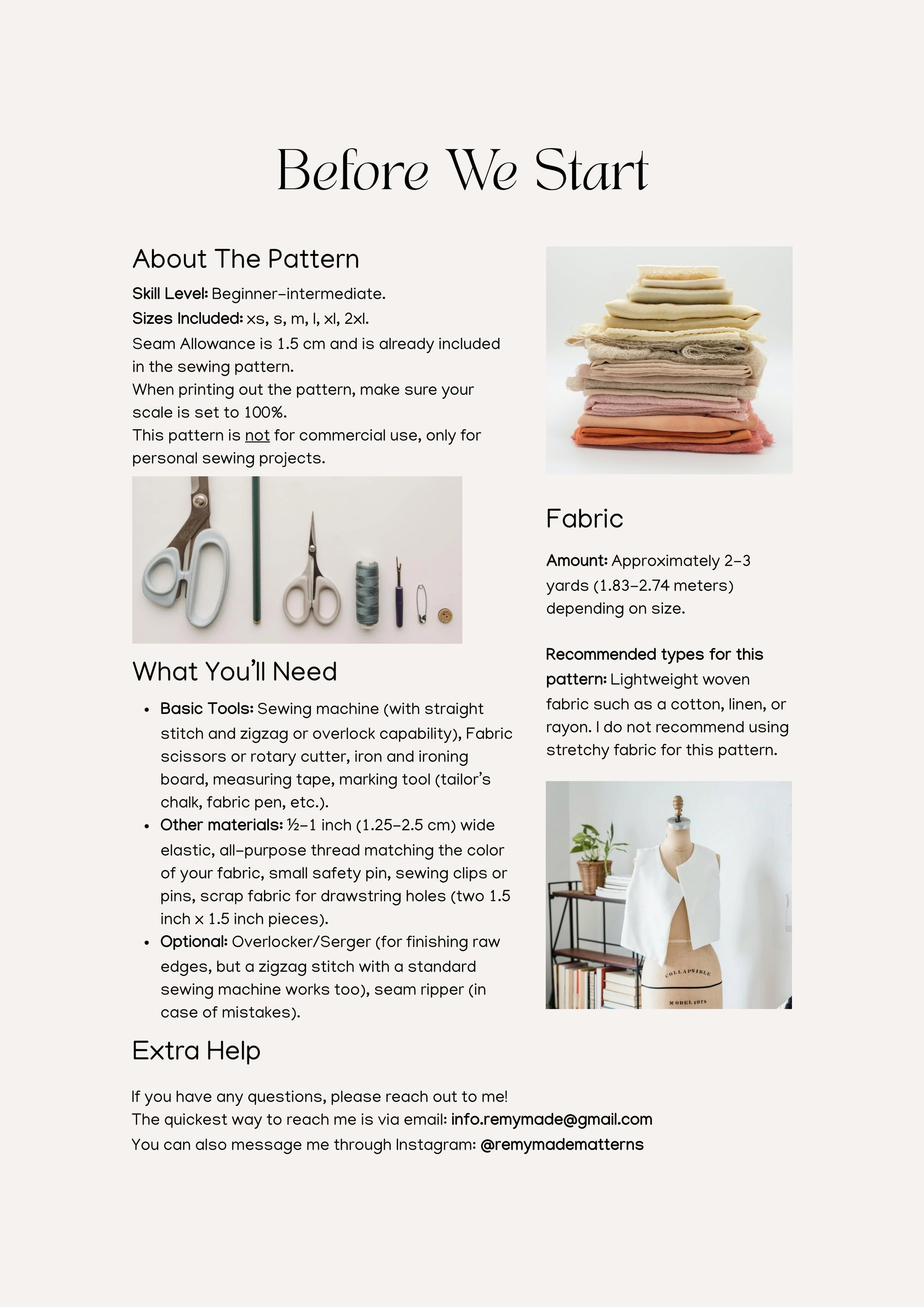
A needle
-
Thread that matches the color of your fabric
-
Scissors
-
Pins or clips to hold fabric in place
-
A thimble (optional, but helpful for pushing the needle through thicker fabric)
How much thread to use
A good rule of thumb is to cut a piece of thread about as long as your arm, roughly 18 to 24 inches.
Any longer and the thread tends to tangle or knot as you sew, which slows you down and wastes thread.
Hand sewing needles
For most fabrics, a medium-sized sharp needle is all you need. Switch to a finer needle for delicate fabrics like silk so it doesn't snag, and a thicker needle for heavy fabrics like denim so it doesn't bend or break.

How to thread a needle by hand
To thread a needle by hand, pass one end of the thread through the eye of the needle, then pull it through until you have a short tail on one side.
If you're having trouble seeing the eye, hold the needle up against a light background or wet the end of the thread slightly to help it stay together as it passes through.
Related article: How to Sew: A Complete Beginner’s Guide
How to tie a knot for hand sewing
To tie a knot for hand sewing, wrap the thread around the tip of your index finger two or three times, then roll the loops off your finger while pinching them between your finger and thumb.
Pull the thread through to form a small, secure knot at the end.
Expert tip: I personally knot my thread at least 4 times in the same spot to make the knot bigger and bulkier, that way there's zero chance of it slipping through the fabric.
How to stitch by hand
To stitch by hand, push the needle up through the back of the fabric, pull the thread through, then push the needle back down through the fabric a short distance ahead: that's one stitch.
Continue repeating this motion, keeping your spacing as even as possible, until you've completed the seam or section you're working on.
How to sew by hand: Step-by-step
Step 1: Thread the needle.
Cut a length of thread and pass one end through the eye of the needle. Avoid using a thread that is too long, as it can easily tangle while sewing.

Step 2: Tie a knot in the thread.
Tie a small knot at the end of the thread to prevent it from pulling through the fabric when you start sewing.

Step 3: Start the stitch.
Insert the needle through the fabric and pull the thread through until the knot catches. This anchors the thread and begins your stitching.

Step 4: Continue sewing.
Move the needle in and out of the fabric to create a series of stitches. Keep your stitches as even as possible for a neat and secure finish.

Expert tip: If you're struggling to keep your stitches in a straight line, use an erasable fabric marker or fabric chalk and a ruler to draw a light line on your fabric before you start sewing. Just stitch along the line, and erase or brush it away when you're done!
Step 5: Tie off the thread.
When you have finished sewing, flip your work to the back side and take a small stitch in place, then pass the needle through the loop and pull tight to form a knot. Repeat once or twice more for extra security.

Step 6: Trim the excess thread.
Cut away the remaining thread, leaving a short tail next to the knot. Your hand sewing is now complete.

How to tie off a stitch
To tie off a stitch, take a small stitch in place on the back of the fabric, then pass the needle through the loop before pulling it tight to form a knot.
Repeat this once or twice more for extra security, then trim the excess thread.
Basic hand sewing tips for beginners
A few simple habits can make hand sewing much easier when you're just starting out. Keep these tips in mind as you practice:
-
Use shorter lengths of thread to avoid tangling.
-
Keep your stitches even and consistent in size.
-
Sew in good lighting so you can see your stitches clearly.
-
Go slowly at first; speed comes with practice.
-
Knot your thread securely before you start sewing.
Fun fact: Ancient peoples used animal sinew as thread, paired with needles made from bone and horn (Britannica).
Types of hand sewing stitches
There are several basic stitches worth learning, each suited to different tasks. Here are the most common ones:
-
Running stitch: used for simple seams and gathering fabric.
-
Backstitch: used for strong, durable seams.
-
Whipstitch: used for finishing edges or joining two pieces of fabric.
-
Blanket stitch: used for edges and decorative finishing.
-
Hemming stitch: used for sewing hems invisibly from the right side.
What Is the difference between sewing and stitching?
Stitching refers to the individual passes of thread through the fabric, while sewing is the broader process of joining fabric together using a needle and thread.
In everyday use, the two words are often used interchangeably.
When to use hand sewing
Hand sewing is useful any time you need more control or precision than a machine can offer. Here are some common situations where it makes sense:
-
Repairing small tears or holes.
-
Sewing on buttons, snaps, or hooks.
-
Hemming pants or skirts.
-
Finishing delicate or hard-to-reach areas.
-
Working on small projects when a machine isn't necessary.
For repairing rips or holes in clothing, check out this guide: How to Sew a Hole in Your Clothes.
What is the easiest thing to sew by hand?
The easiest thing to sew by hand is usually a button, since it only requires a few simple stitches to attach securely.
For a detailed guide on how to sew a button, read here: How to Sew a Button in Just a Few Simple Steps.
Hemming a straight edge is a close second, as it just involves a basic, repetitive stitch.

Common hand sewing mistakes and how to fix them
Why do my knots pull through the fabric?
Your knots are likely pulling through because they're too small or the fabric is loosely woven.
Try making a slightly larger knot, or take a tiny anchor stitch in the fabric before tying off to give the knot something to catch on.
Why does my thread keep getting knotted or twisted while I sew?
Your thread is probably knotting or twisting because it's too long or twisting as you pull it through the fabric.
Cutting a shorter length of thread and occasionally letting the needle hang freely to untwist can help prevent this.
Why does my needle keep getting stuck or hard to pull through?
Your needle is likely getting stuck because it's too thick for your fabric or the fabric is tightly woven.
Switching to a finer needle or using a thimble to help push it through can make this much easier.
Why are my hand stitches coming undone in the wash?
Your stitches are probably coming undone because the knots weren't tied securely or the thread wasn't strong enough for the project.
Make sure to double-knot your thread and use a sturdy thread suited to the fabric type for stitches that hold up over time.
Fun fact: For roughly 20,000 years, hand sewing with needles and thread remained essentially unchanged. It wasn't until the 1850s that the sewing machine arrived in American homes and changed everything (SFO Museum).
FAQ
Is sewing by hand difficult?
Sewing by hand really isn't difficult, even if it feels intimidating at first. With just a few basic stitches and a little practice, you'll be making clean, secure repairs in no time.
Can I hand sew like a sewing machine?
You can't sew exactly like a sewing machine by hand, but you can create strong, neat stitches that work just as well for many projects.
What needle is best for hand sewing?
A general-purpose sharp needle is the best choice for most hand sewing projects.
That said, the right needle can vary by fabric: a sharp needle works well for lightweight to medium fabrics like cotton or linen, a heavier needle handles thicker fabrics like denim or canvas, and a fine needle is better for delicate fabrics like silk or chiffon.
What thread should you use for hand sewing?
An all-purpose polyester thread is the best choice for most hand sewing projects.
However, the right thread can vary by fabric: cotton thread is a good match for natural fabrics like cotton or linen, while a fine silk thread is better suited for delicate fabrics since it glides through without snagging.
What is the easiest hand sewing stitch for beginners?
The running stitch is the easiest hand sewing stitch for beginners because it's simple and repetitive.
Why are my hand stitches uneven?
Your hand stitches are likely uneven because of inconsistent spacing or tension, which usually improves with practice.
Can you hand sew without a thimble?
You can 100% hand sew without a thimble, though it may be less comfortable when working with thicker fabric.
Is hand sewing strong enough to hold fabric together?
Hand sewing is strong enough to hold fabric together when done with secure stitches and sturdy thread.